 Get in touch
 English
  English
 中文简体
中文简体 русский
 Español
 عربى
عربى Français
 Português
 Deutsch
 বাংলা
বাংলা 日本語
日本語 Polskie
 italiano
 Türk
Türk 한국어
한국어 ไทย
ไทย
Water pooling on a synthetic lawn or pitch is almost never the carpet's fault. In the installations we are called out to inspect, the cause sits 20 to 40 cm below the surface: a base graded too flat, stone that was never going to drain, or a weed membrane that seals up within a season. So here is the short answer before the detail - an artificial turf drainage system is not a pipe and it is not a product. It is a layered build-up of compacted subgrade, separation geotextile, clean drainage stone, a fine blinding layer, an optional perforated pipe network, and only then the turf itself. Each layer has one job, and if one is skipped, the surface above it will eventually sit in water.
What follows is what each layer actually does, the depth, gradation and slope numbers worth writing into a specification, how sports pitches differ from gardens and rooftops, and the mistakes that are cheap to avoid and very expensive to repair.
Content
- 1 What an Artificial Turf Drainage System Actually Is
- 2 Sub-Base Depth and Stone Gradation: The Numbers Worth Specifying
- 3 Slope: The Number Most Installers Get Wrong
- 4 Sports Pitches, Gardens and Rooftops: Three Different Drainage Briefs
- 5 Comparing Base Systems: Which One Fits the Site
- 6 Six Mistakes That Kill a Drainage System
- 7 Maintenance That Keeps Water Moving
- 8 Frequently Asked Questions
What an Artificial Turf Drainage System Actually Is
An artificial turf drainage system is the layered base construction beneath the carpet that collects and removes water - the turf only decides how quickly water enters that base.
Rain falls on the pile, passes through the punched holes in the backing, crosses the shockpad where one is used, and enters the base. From there, water moves in two directions: vertically into the subgrade, and laterally through the voids between the stones towards the edge of the field or a perforated pipe. Peak rainfall is managed by storage. The stone layer temporarily holds water and releases it over the following hours, which is why depth and void space matter as much as slope.
| Layer | Typical specification | What it does | How it fails |
|---|---|---|---|
| Compacted subgrade | Graded to a continuous fall, compacted in layers | Stable platform and final outfall | Soft spots, no fall, roots left in place |
| Separation geotextile | Non-woven, roughly 150-250 g/m2, high water permeability | Stops fines pumping up into the stone | Woven fabric or plastic sheeting, which blinds the base |
| Drainage stone | 100-150 mm of washed 20-40 mm crushed stone | Stores and conveys water laterally | Rounded river gravel, crusher run, excess fines |
| Blinding layer | 30-50 mm of washed 5-10 mm gravel | Firm, level, still permeable | Limestone dust, over-compaction |
| Perforated pipe (optional) | 110 mm pipe at 5-6 m centres with clear outlets | Empties low points and edges | No outlet, no filter sock, crushed by machinery |
| Shockpad (sports only) | 10-25 mm open-cell, permeable pad | Impact absorption under the playing surface | Closed-cell foam or sealed joints |
| Turf and backing | 30-60 mm pile with perforated backing | The visible playing or landscape surface | Blocked backing holes, glue-sealed seams |
Sub-Base Depth and Stone Gradation: The Numbers Worth Specifying
For most installations, plan on a total base depth of 150-250 mm of clean, single-size crushed stone with less than 3% fines, laid over a graded subgrade - depth alone will not drain anything if the stone is dirty.
Fines are the enemy. Particles below about 0.075 mm settle into the voids between stones and turn a drainage layer into a sponge. A supplier's certificate is useful, but a jar test is faster: half-fill a clear jar with stone and water, shake it hard, then let it stand for twenty minutes. A visible silt layer means the material should be washed or rejected.
Stone shape matters too. Angular crushed stone interlocks and keeps roughly 30-40% void space, which is where the water actually lives during a storm. Rounded river gravel packs tightly, offers far fewer voids, and is one of the most common cost-saving substitutions that later becomes an excavation job.
Depth is set by use. Sports fields generally need 150-250 mm of drainage stone plus a pipe grid. A domestic or commercial lawn over reasonable soil can work with around 100 mm of 20-40 mm stone topped by 30 mm of washed 5-10 mm gravel. Rooftops are the exception: a stone base may exceed the structural budget entirely, so lightweight manufactured drainage panels are used instead.
Slope: The Number Most Installers Get Wrong
Aim for a continuous 1% fall - 1 cm per metre - from the high point towards the outlets, and treat 0.5% as an absolute minimum that only holds up with laser grading.
Water leaves a base by gravity. On a crowned pitch, that means a fall from the centre line down to both touchlines; on a garden or courtyard, a single plane towards a soakaway or a drainage channel. The common failure is not the headline gradient but the local dips: a 3 m soft spot in an otherwise perfect 1% plane will collect a puddle that never dries. Grade with a laser screed or total station and verify on a 2 m grid with a rotating laser before the turf is ever unrolled.
On rooftops and balconies, you rarely control the slope at all - the roof's own fall governs. In that case, water must be kept above the waterproof membrane and steered to existing outlets, which is why low-profile drainage panels are used instead of a thick aggregate layer.
A five-minute hose test at the low point tells you almost everything. Once the water is switched off, any puddle deeper than a few millimetres should be gone within minutes, and no water should remain after half an hour.
Sports Pitches, Gardens and Rooftops: Three Different Drainage Briefs
A football pitch is designed around a storm event, a garden around decades of low maintenance, and a roof around a strict weight budget - the same turf can sit on all three, but the base underneath cannot be copied from one to the next.
On sports fields, drainage is a performance specification, not a comfort feature. The base is usually a piped grid inside the stone, and the shockpad must stay open so that impact absorption, tested under procedures such as ASTM F355-10a, is not lost when the surface is saturated. Playability after rain is the acceptance criterion: the field should clear a heavy shower quickly enough for a match to restart without standing water.
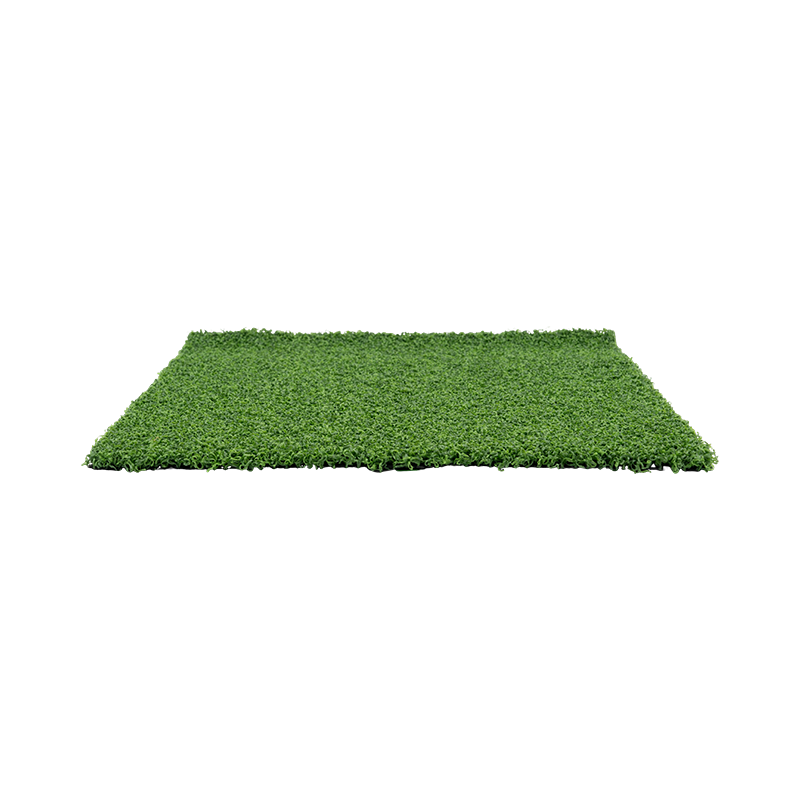
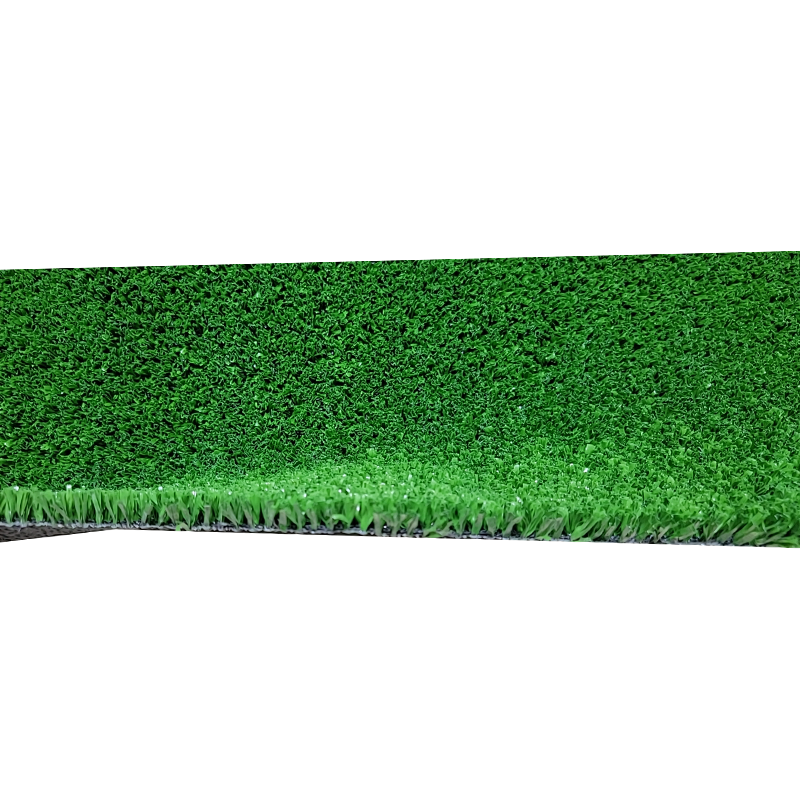
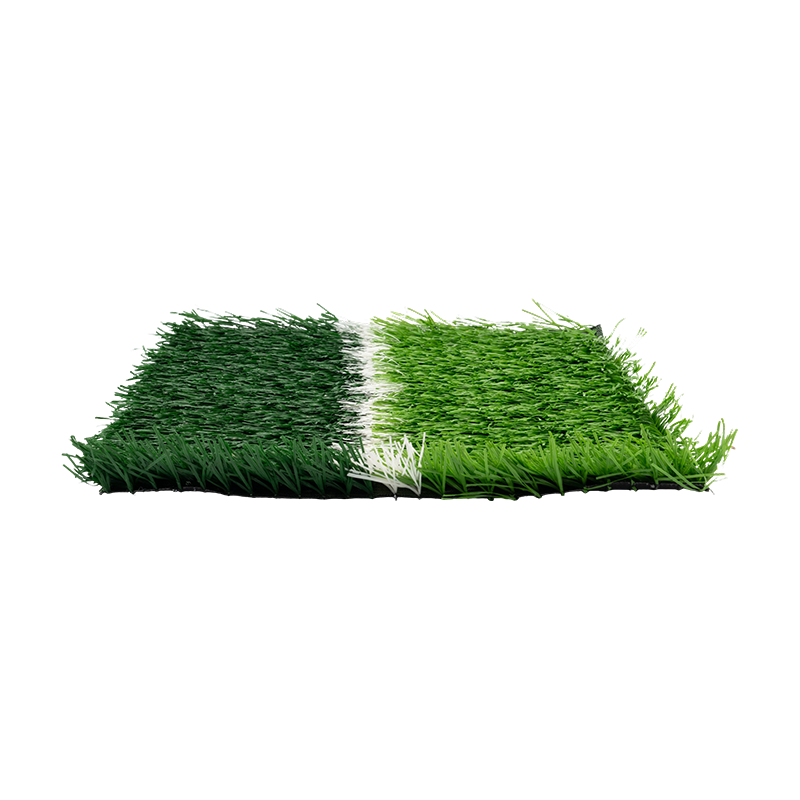 Artificial Turf for Football Pitches with Unfilled StructureUnfilled mesh turf designed for football pitches, offering drainage and ball feel suited to fields expected to recover quickly after heavy rain.View Product →
Multi-use courts and tennis courts follow the same logic but with tighter tolerances for ball bounce, which is why sports artificial turf systems are usually specified as a complete package of base, pad and carpet rather than as a roll of material.
Landscape installations in gardens, verges, hotels and school grounds normally rely on infiltration alone. That works well on sandy or free-draining soil and fails badly on clay. If the ground holds water, break up the subgrade, keep the fall, and add a collector drain at the lowest edge rather than hoping the clay will absorb the rain.
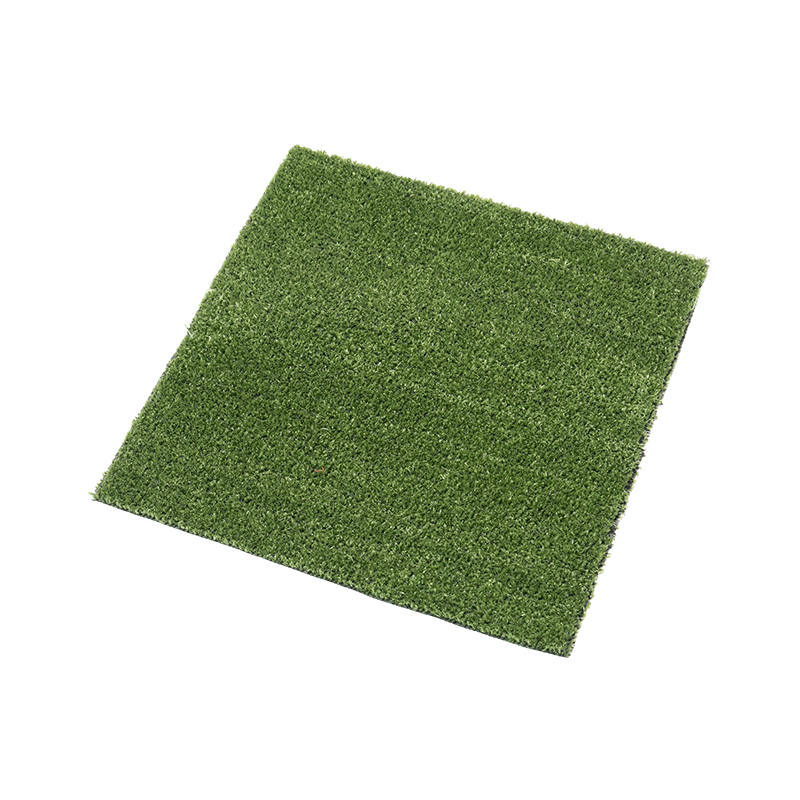 Lightweight Artificial Turf for Rooftop Terraces and DecksLightweight synthetic grass for roofs, combining decorative greenery with permeable drainage to reduce structural load and keep rooftop outlets clear.View Product →
Rooftops, terraces and podium decks have a different problem: every extra kilogram of saturated stone is a structural load, and the roof outlets must never be obstructed. Here a manufactured drainage panel, 20-30 mm thick, replaces the stone entirely and keeps water moving horizontally to the existing outlets.
Comparing Base Systems: Which One Fits the Site
There is no single best base - there is a base that matches the subsoil, the rainfall, the weight limit and the way the surface will be used.
| Base system | How water leaves | Best suited to | Main risk |
|---|---|---|---|
| Aggregate base with perforated pipes | Percolation into stone, lateral flow to pipes and outlets | Sports pitches, large lawns, heavy rainfall regions | Excavation cost; requires genuinely clean stone |
| Aggregate base, infiltration only | Vertical percolation into the subgrade | Gardens on sandy or free-draining soil | Fails on clay; needs a reliable 1% fall |
| Geocell-confined base | Stone held in cells, drains vertically through the grid | Pet areas, narrow strips, edges, light vehicle access | Still needs stone and a discharge point |
| Manufactured drainage panel | High-void sheet moves water sideways | Rooftops, balconies, terraces, weight-limited decks | Compressive strength limits; higher unit cost |
| Solid base with surface channels | Surface run-off to channels and gullies | Hard courts, patios, roof edges | No storage; slopes and channel levels must be exact |
Six Mistakes That Kill a Drainage System
Almost every drainage failure we see traces back to one of six decisions, and five of them are made before a single roll of turf is delivered.
- Grading "flat" and calling it level. A base with no fall stores water permanently; the surface only dries by evaporation.
- Buying on price per tonne. Crusher run, quarry dust and rounded gravel look acceptable on a delivery note and fail within two seasons.
- Laying plastic sheeting or fine-mesh weed membrane across the base. Both block the vertical path for water and turn the base into a bathtub.
- Over-gluing the seams. Excess adhesive seals the perforations along the joint, and the first visible symptom is a thin strip of water along every seam.
- Forgetting the outlets. A perforated pipe without a discharge point simply relocates the water into the base, where it stays.
- Over-compacting the blinding layer to make it "nice and firm". Voids close, permeability drops, and the layer becomes decorative rather than functional.
Maintenance That Keeps Water Moving
A drainage system keeps working when the pile stays open and the outlets stay clear, which is why brushing, topping up infill and an annual outlet check matter more than any additive.
- Brush the surface regularly to lift the pile and redistribute infill; compacted, flattened fibres slow the entry of water.
- Top up infill to the specified level rather than over-filling, since too much fine sand migrates into the base over time.
- Inspect and flush pipe outlets once a year, and clear leaves, moss and organic debris from the low side of the installation.
- Keep vehicle traffic off the base before turf is laid, and machinery off the surface afterwards.
- In pet areas, rinse and use an enzyme cleaner weekly; drainage and odour control are the same problem seen from two angles.
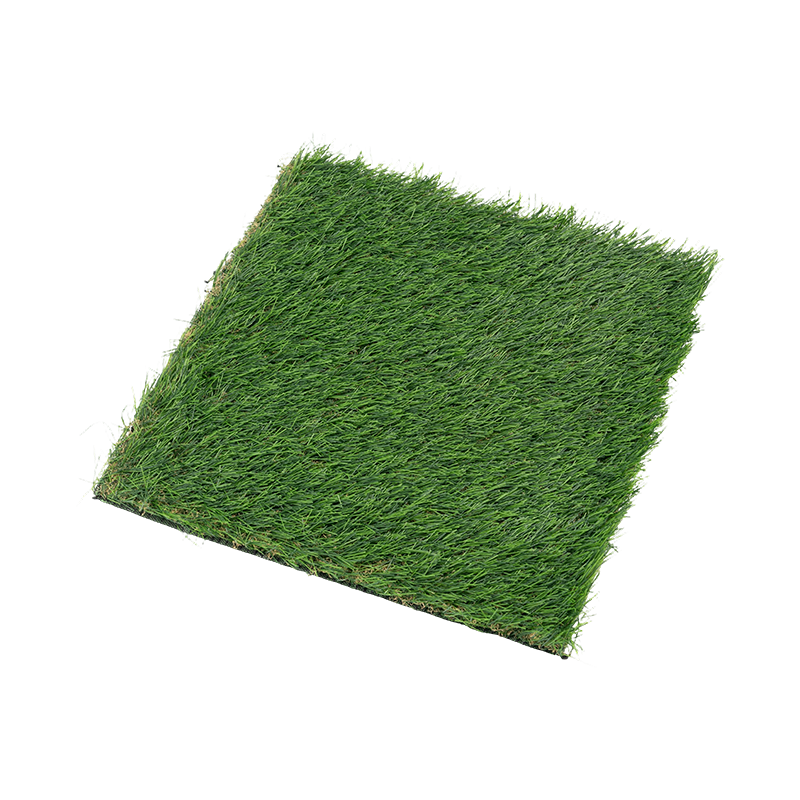 PP+PE Artificial Turf for Pet Play AreasDual-material pet turf with drainage and slip resistance, suited to patios and play areas that need easy cleaning and durable fibers against scratching.View Product →
Frequently Asked Questions
How deep should the base be under artificial grass?
For a garden lawn, around 100 mm of washed 20-40 mm stone plus a 30 mm blinding layer of 5-10 mm gravel is usually enough. Sports pitches typically need 150-250 mm of stone plus a pipe grid, because the base has to store water during a storm, not just pass it through.
Does artificial turf always need a drainage pipe?
No. If the subgrade drains freely and the surface has a consistent fall, infiltration is sufficient. Pipes become necessary on clay, in enclosed courtyards, on heavy-use fields and anywhere water has no natural escape route.
How fast should water disappear after rain?
Any standing water should be gone within a few minutes of the rain stopping, and nothing should remain after half an hour. Persistent puddles deeper than a few millimetres mean the base is holding water rather than moving it.
Can artificial turf be laid over concrete?
Yes, but the water must leave over the surface. Slope the concrete towards a gully, or add a manufactured drainage panel above it. Laid flat, a film of water - and, in winter, ice - will sit under the carpet.
The practical summary is simple: decide where the water goes before you decide which turf to buy. Depth, gradation, slope and outlets do the work; the carpet is the last 30 mm of the story. On large or unusual sites - clay subgrades, rooftops, multi-use courts or shapes that do not follow a standard rectangle - the base design is worth engineering properly, and firms that handle design, supply and installation under one contract tend to catch these problems before the excavation is backfilled rather than after. For non-standard layouts and shapes, see our custom turf projects, where the base detail is matched to the site rather than to a catalogue.

 +86-19742095266
  zoe_canyoograss@163.com
  No.18 Baqiao, Xinji Yizheng, Yangzhou, Jiangsu. P.R. China